



Live online cohort · ages 8–18
Public Speaking, Communication & Leadership Cohort
From freezing up to holding the roomKnows the answer, but won't put a hand up?Speak with calm. Lead the room.A clear way to answer any question, even under nervesChatty at home, silent with guests?
Your child learns to speak with calm, make one clear point and lead a discussion.Six weeks: from breath and posture in a small group to a talk to a live panel.Presence, structure, listening and debate. In week six, your child runs a discussion.For the interviews ahead: structure, answers without a script, argument and rebuttal.Week four is speaking without a script. After six weeks, a talk to a live panel.
- 12 live sessions over 6 weekends, online, from late December 2026.
- Ages 8–11, 12–14 and 15–18, never mixed. Up to 10 in a group.
- Ends with a talk to a live panel, filmed and edited for you.
Next: a free 30-minute Strengths Profile for your child, then a 20-minute call where you hear the fee. Full refund within 7 days of the first session.

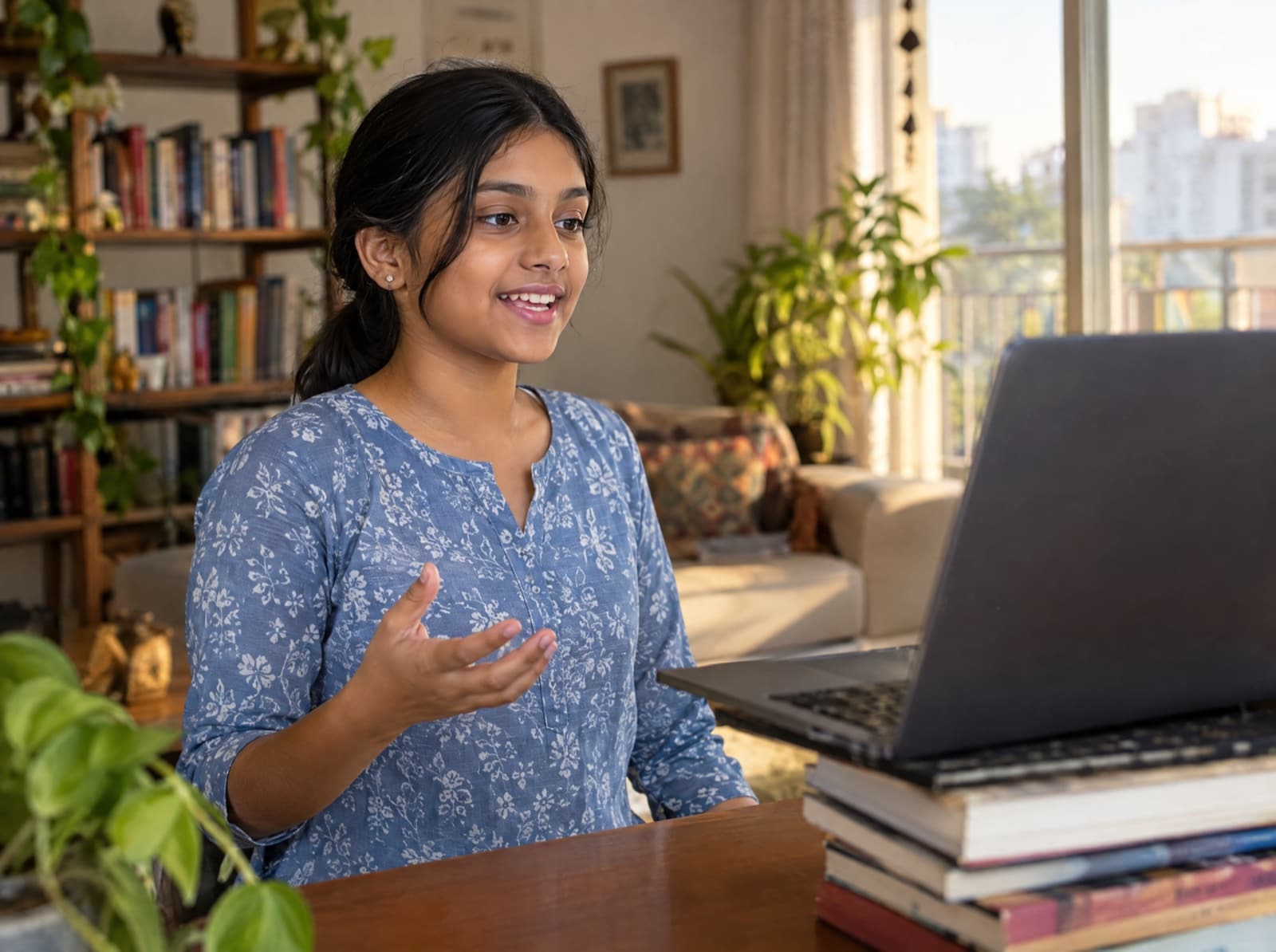

Public Speaking, Communication & Leadership is a 6-week live online public speaking course for ages 8–18 in which each child gives a talk to a live panel, filmed and edited, and gets a before-and-after reel.
Public Speaking, Communication & Leadership at a glance
- Ages
- 8–18, in age groups 8–11, 12–14 and 15–18, never mixed
- Length
- 6 weeks
- Format
- Live online. Two live sessions each weekend, plus 10 minutes of practice a day.
- Each live session
- 60–120 minutes
- Group size
- Up to 10 children in a group.
- First batch
- Late December 2026
- Taught by
- A specialist speech or debate coach with 10+ years of experience.
- Judged by
- An industry veteran communicator and LevelUp's founder, who has given a TEDx talk.
- What they make
- A talk delivered live to the panel, filmed and edited, plus a before-and-after reel.
- AI use
- Barely uses AI. No AI analysis of children's voices.
Speaking with confidence is an unfair advantage.It can be taught.
Two children can know the same answer. The one who says it clearly, with people watching, gets heard. Schools mark what children write. Few teach them to say it.
- In class
Teachers pick the child who can explain
Class presentations, the debate team, house captain. A child who speaks up once gets asked again.
68%of a school year: the extra progress in English made by students who joined debate.
Schueler and Larned, 2023 (Boston, US)
- In class
Teachers pick the child who can explain
Class presentations, the debate team, house captain. A child who speaks up once gets asked again.
68%of a school year: the extra progress in English made by students who joined debate.
Schueler and Larned, 2023 (Boston, US)
- Admissions
Interviews settle the close calls
Colleges in India and abroad meet applicants before they say yes, in an interview or a group discussion.
35%of the final score for IIM Indore's five-year programme is the interview. Students apply after Class 12.
IIM Indore, IPM 2026–31 admission procedure
- Work
Employers hire the clear speaker
Marks get a candidate shortlisted. The interview decides the offer.
37%of Indian hiring leaders name communication as the skill they want most.
Michael Page India Talent Trends 2025, 1,383 leaders
- With AI everywhere
AI can write the essay. Your child has to defend it.
When every child can hand in a polished draft, what counts is what they can say out loud when the next question comes.
61%of employers count leadership and social influence as a core skill.
World Economic Forum, Future of Jobs Report 2025
At 9, your child has years to use this before any interview counts.At 13, the habit can set in before board exams, school elections and the first debates.At 16, college interviews and group discussions are a year or two away. This is practice for them.
Apply now 2 minutes · no paymentSigns your child is ready for this
Tap the ones you've seen at home. Next to each is the week that works on it.
Nothing ticked yet.

Seen two or more?
Apply now 2 minutes · no paymentHow much time does it take each week?
Two live sessions each weekend, plus 10 minutes of practice a day. Each live session runs 60–120 minutes. Each week adds one skill, and each skill goes into the talk your child gives at the end.
A normal week
- Mon10 min
- Tue10 min
- Wed10 min
- Thu10 min
- Fri10 min
- Weekend2 live sessions
Each live session runs 60–120 minutes, with two adults. For practice rounds the group splits into two pods of four or five, each with an adult, so a quiet child gets turns before facing the whole group.
Week 1: Presence
Breath, posture, eye contact, pace and pause. A baseline 60-second recording.
Sample practice: Say your opening line to someone at home, slowly, eyes up.
Week 2: Structure
Point, example, close. Strong openings, clean endings, speaking to time.
Sample practice: Answer one question from a parent with a point, an example and a close.
Try it belowWeek 3: Listening
Active listening, asking good questions, reading the room and body language.
Sample practice: Ask a family member about their day, then say back what you heard.
Week 4: Story and impromptu
Telling personal stories, and thinking on your feet when there is no script.
Sample practice: Talk for one minute on a topic someone else picks.
Week 5: Persuasion and debate
Argument, evidence and rebuttal, and how to disagree with respect.
Sample practice: Argue the other side of your own view for one minute.
Week 6: Leading a room
Running a discussion, giving feedback, and rehearsing the final talk.
Sample practice: Give the whole talk once, standing up, start to finish.
The end
Final Review
A talk delivered live to the panel, filmed and edited, plus a before-and-after reel.
Who judges it
Build a talk
Children often freeze because they don't know what comes next. Week 2 gives them four parts: hook, point, example, close. Put the cards in order.
Sample topic
Why every child should look after a plant
Drag the cards into order, or click two cards to swap them.Drag a card by its dotted handle, or tap two cards to swap them.With a keyboard, the up and down arrow keys move the focused card.
0 of 4 in place
ExampleNow I water mine every morning before school. When a new leaf comes out, I know I did that.
CloseSo ask for one small plant. Keep it alive for a month, and see what else you start looking after.
PointI think every child should look after one plant, because it teaches you to keep a promise.
HookLast summer I forgot to water my tulsi plant for four days. It nearly died, and I felt terrible.
In this order it doesn't hold together yet.
The first batch starts late December 2026.
Apply now 2 minutes · no paymentWho teaches Public Speaking, and who judges the final talk?
- Taught by
- A specialist speech or debate coach with 10+ years of experience.
- Background-verified. Named here before the first batch. A second adult joins every live session.
- Judged by
- An industry veteran communicator and LevelUp's founder, who has given a TEDx talk.
- Your child gives the talk live to the panel. You watch online.
- Graded
- Distinction, Merit or Pass, against a rubric you get in week 1.
- Theirs to keep
- The certificate, the talk filmed and edited, and the before-and-after reel.
LevelUp has taught 75,000+ learners, most of them adults.
You see how it is going, without sitting in
Your child works with the coach. You still know what happened each week.
- Week 1
- The grading rubric, so you know the standard from the start.
- Every Friday
- A Progress Note on WhatsApp.
- Within 48 hours
- Written feedback on your child's work.
- All along
- A parents-only WhatsApp group with the team.
- The last weekend
- You watch the Final Review live, online.
- Afterwards
- The edited talk, the before-and-after reel and the graded certificate, to keep.
You hear the fee on a 20-minute call, before you decide. Full refund within 7 days of the first session.
How do you keep my child safe?
Two adults join every live session, and your child's voice stays with people, not software. A speaking cohort puts your child's voice and face on a screen; here is how we look after both.
All our safety commitmentsNo AI listens to your child
Feedback comes from the coach and the panel.
Recordings deleted within 90 days
Sessions are recorded for safety review only. The final talk is filmed and edited for your family.
Camera on is encouraged, never required
A shy child can start with it off.
No private messages to children
Parents get a WhatsApp group with the team.
Apply now. Pay only if it fits.
Nothing to pay to apply. A counsellor tells you the fee after your child's profile, before you decide.
- 1
Apply · 2 minutes
Your child's age, your names and your WhatsApp number.
- 2
Strengths Profile · 30 minutes, free
Your child does it now or at a time you pick. Not an IQ test.
- 3
Counsellor call · 20 minutes
We go through the report, tell you the fee and any scholarship, and say plainly whether this cohort fits or another one does.
- 4
A seat
Pay by link, only if you want it.
Top 10% of each age band earn a merit scholarship · First batch late December 2026 · Up to 10 children, one age group
You hear the fee on a 20-minute call, before you decide. Full refund within 7 days of the first session.
Common worries
How much does it cost?
The counsellor shares the fee on your free 20-minute call, after your child's Strengths Profile, along with any scholarship your child earns. The top 10% of each age band earn a merit scholarship.
What if it isn't right for my child?
Tell us within 7 days of the first session and we refund the full fee.
My child is very shy. Is this too much?
That's who this is for. Week 1 starts with breath, posture and a 60-second recording. Practice rounds happen in pods of four or five, each with an adult. Groups never mix ages, and cameras are encouraged, never required.
How many live sessions are there?
12 live sessions, two each weekend for 6 weeks, 60–120 minutes each. On weekdays, 10 minutes of practice at home.
Will it clash with school exams?
Live sessions are on weekends, and weekday practice takes 10 minutes. The first batch starts late December 2026. If your child has board exams early in 2027, raise it on the call before you take a seat.
What if my child misses a session?
Tell your counsellor. Your child can use their one-to-one mentor time to catch up. The Final Review is live, so ask for its date before you take a seat.
Will you keep calling me?
No. There is one call: the 20-minute session, at a time you pick. Everything else comes on WhatsApp, and if you say stop, we stop.
What device does my child need?
Any laptop, tablet or phone that can join a video call. A laptop or tablet shows the group best.
Does it use AI?
Barely. No AI analyses your child's voice, and feedback comes from people, not software.
Who teaches?
A specialist speech or debate coach with 10+ years of experience, background-verified and named here before the first batch. A second adult joins every live session.
How are the age groups split?
Your child joins one of three groups: 8–11, 12–14 and 15–18, never mixed.
How many children are in a group?
Up to 10 children in a group, all from one age group.
Is it online?
Yes. All 12 live sessions are online, on weekends, and you watch the Final Review online too.
What will my child make?
A talk delivered live to the panel, filmed and edited, plus a before-and-after reel. Both are theirs to keep.
Is there a certificate?
Yes. The panel grades your child's talk Distinction, Merit or Pass, against a rubric you get in week 1. Your child keeps the graded certificate.
Next time someone asks them a question, they'll know where to start
Six weekends from late December 2026. Groups of up to 10, by age. A talk to a live panel at the end, filmed for you to keep.
You hear the fee on a 20-minute call, before you decide. Full refund within 7 days of the first session.
Compare all four cohorts